Mr. Brovsky's Office
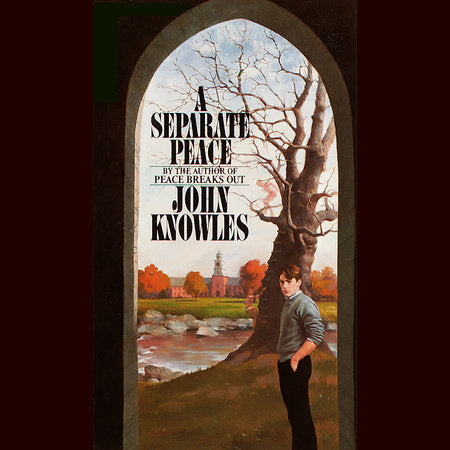
Introduction to Literature: A SEPARATE PEACE, John Knowles
Regular price
$19.99 USD
Regular price
Sale price
$19.99 USD
Unit price
per
Couldn't load pickup availability
Publishing date: 1960 (U.S.A.) 210 pages
Dialectic Journal/Lesson Plans: 78 pages, 30,645 words
"I think we ought to bomb the daylights out of them, as long as we don’t hit any women or children or old people, don’t you?” says Phineas, the radiant subject of Gene’s obsession in A Separate Peace. It is 1942, and news has just broken of the bombing of Central Europe. Where in Europe? Phineas can’t remember. Nor can he remember whether it was the American, British, or Russian air forces who did the bombing. He appears to be the only person who noticed the event in the newspaper, but he can’t recall which newspaper he read it in. No hospitals should be bombed, he adds, “and naturally no schools. Or churches.”
Separate Peace is one of those books that can easily be spoiled by being taught badly in high school. (Other classics of this genre include Of Mice and Men, The Catcher in the Rye, and The Lord of the Flies.) One friend told me at length how frustrating she had found the novel; how little she had found to connect with as a Chinese-American at a California public school, even though she often related to books about experiences different from her own. (6)
But there is something universal at the heart of A Separate Peace, something ineffable and intangible. I can’t put it into a neat sentence—it took the whole book to transmit that inexpressible something from Knowles’s heart into mine. It is a book that is deliberately ambiguous, that carefully avoids telling the reader what to believe. It is not meant for didactic teaching; you cannot prove what happened between Phineas and Gene in the central event of the novel (6)
Share